
2025 Sustainability Audit Report
A Roadmap for Local News Sustainability


Lion's Stages of Sustainability


There's a reliable linear progression as an organization progresses through the stages. Building organizations have more staff than Preparation organizations, Maintaining organizations have higher revenue and more staff than Building organizations, and Growing organizations have more of everything than those in all other stages. Organizations that followed up their Audit with a second assessment implemented a great deal of additional practices, which is reflected in the stage distribution at each phase.
Proportional stage assignment after implementing new activities
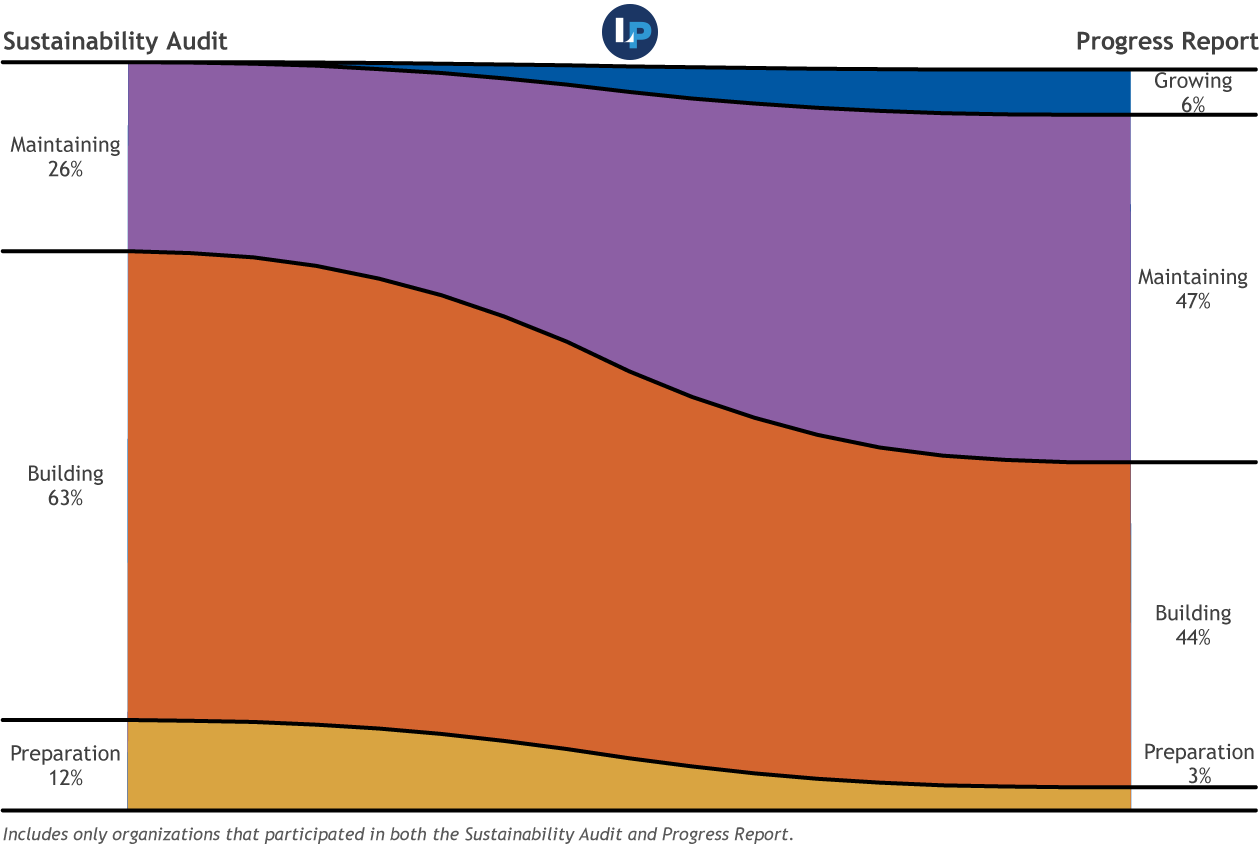
We asked three questions of the data for organizations within each stage to assess areas of strength and opportunity:
- What differentiates organizations at the various stages and within stages, both in terms of activities in place and organizational data such as staff and revenue?
- What are key characteristics and practices necessary for an organization to progress from one stage to the next?
- What changed in terms of revenue and staff for organizations that added new activities between assessments?
What’s in a Stage
Organizations tend to grow revenue, staff and audience as they progress through the stages. For example, organizations at the final stage, Growing, have median revenue about 3.75 times greater than at the previous stage, Maintaining. Similarly, organizations at the Maintaining stage report median revenue 5.75 times greater than the prior stage, Building. And Building organizations have median revenue about 2.5 times greater than the initial stage of development, Preparation.
Stage
Number of
organizations
Age
Full-time
employees
Total paid
contributors
Revenue
DAMU
Newsletter
subscribers
Key indicators
selected
Preparation
45
3
0
1
$20,783
6,000
1,300
10%
Building
193
4
1
6
$73,000
18,000
2,380
32%
Maintaining
105
8
5
13
$490,061
57,500
8,500
64%
Growing
14
8.5
19.5
28.5
$2,353,980
230,364
40,000
85%
Preparation Stage
Number of organizations
45
Age
3
Full-time employees
0
Total paid contributors
1
Revenue
$20,783
DAMU
6,000
Newsletter subscribers
1,300
Key indicators selected
10%
Building Stage
Number of organizations
193
Age
4
Full-time employees
1
Total paid contributors
6
Revenue
$73,000
DAMU
18,000
Newsletter subscribers
2,380
Key indicators selected
32%
Maintaining Stage
Number of organizations
105
Age
8
Full-time employees
5
Total paid contributors
13
Revenue
$490,061
DAMU
Newsletter subscribers
8,500
Key indicators selected
64%
Growing Stage
Number of organizations
14
Age
8.5
Full-time employees
19.5
Total paid contributors
28.5
Revenue
$2,353,980
DAMU
230,364
Newsletter subscribers
40,000
Key indicators selected
85%
Significant revenue growth early on is an excellent measure of how well an organization is doing. But at a certain point, revenue might not need to increase if the organization decides to stabilize rather than continue to scale.
Growing the number of revenue sources, so that the loss of any one source is not catastrophic, is another key sign on the path to sustainability. Typical sources might include foundations, major donors, members or subscribers, advertising or sponsorships. Impact Architects has used the following three point scale for understanding and classifying revenue mix:1
1 = one primary revenue stream that encompasses 80 percent or more of total revenue
2 = one revenue stream that encompasses 60 percent or more of total revenue, with the remaining coming from other sources
3 = three or more revenue streams, none greater than 60 percent of total revenue
We see organizations consistently diversifying their revenue as they move through the stages, with the biggest gap between Maintaining and Growing.2
- Preparation: 1.7
- Building: 2.0
- Maintaining: 2.2
- Growing: 2.8
Preparation organizations typically have one sizable revenue stream, Building and Maintaining organizations typically have two, and Growing organizations will likely have at least three. Developing a third significant revenue stream is an important growth milestone.
Key Activities
The analysis that follows digs into what key activities and organizational metrics across the maturity model mean for news organizations and journalism support organizations that want to help them.
It uses the 21 key activities as defined by LION, with the support of Impact Architects, to illustrate what characteristics define organizations in each stage, including challenges and opportunities across the sustainability pillars. The emphasis on key activities across stages will highlight what organizations did at given moments, what resources they had, and where they went from there.



Read the full report
Footnotes
- Impact Architects and Knight Foundation. "Knight Foundation's Investments in Local News Sustainability: Early Learnings and Insights." https://knightfoundation.org/wp-content/uploads/2022/05/Investments-in-Local-News-Sustainability-Early-Learnings-and-Insights.pdf
- The average revenue mix by stage excludes 12 organizations (6 Building, 5 Preparation, 1 Maintaining) that have no revenue or otherwise reported "0" for all revenue streams.

Contact
If you’re interested in learning more about the data in this report, please email LION’s Director of Data and Evaluation, Chloe Kizer at chloekizer@lionpublishers.com.
If you’re interested in learning how the LION Sustainability Audit can help the news businesses you work with, please reach out to Andrew Rockway at andrewrockway@lionpublishers.com.