
2025 Sustainability Audit Report
A Roadmap for Local News Sustainability


Preparation Stage
Where to Start
Thirteen percent of the Audit-takers landed in the Preparation stage. These organizations had relatively few key indicators in place, as they were often young and led primarily if not exclusively by the organization’s founder. The median Preparation organization was three years old, did not have any full-time employees, had revenue of about $20,000, and had a small digital audience (6,000 monthly site visitors and 1,300 newsletter subscribers).
In this early stage, organizations faced the most challenges in Operational Resilience. Overall, they needed to develop basic practices such as bookkeeping, defining a mission, and identifying target audience(s).
Preparation organizations have relatively few practices in place, with the most notable challenges in Operational Resilience.
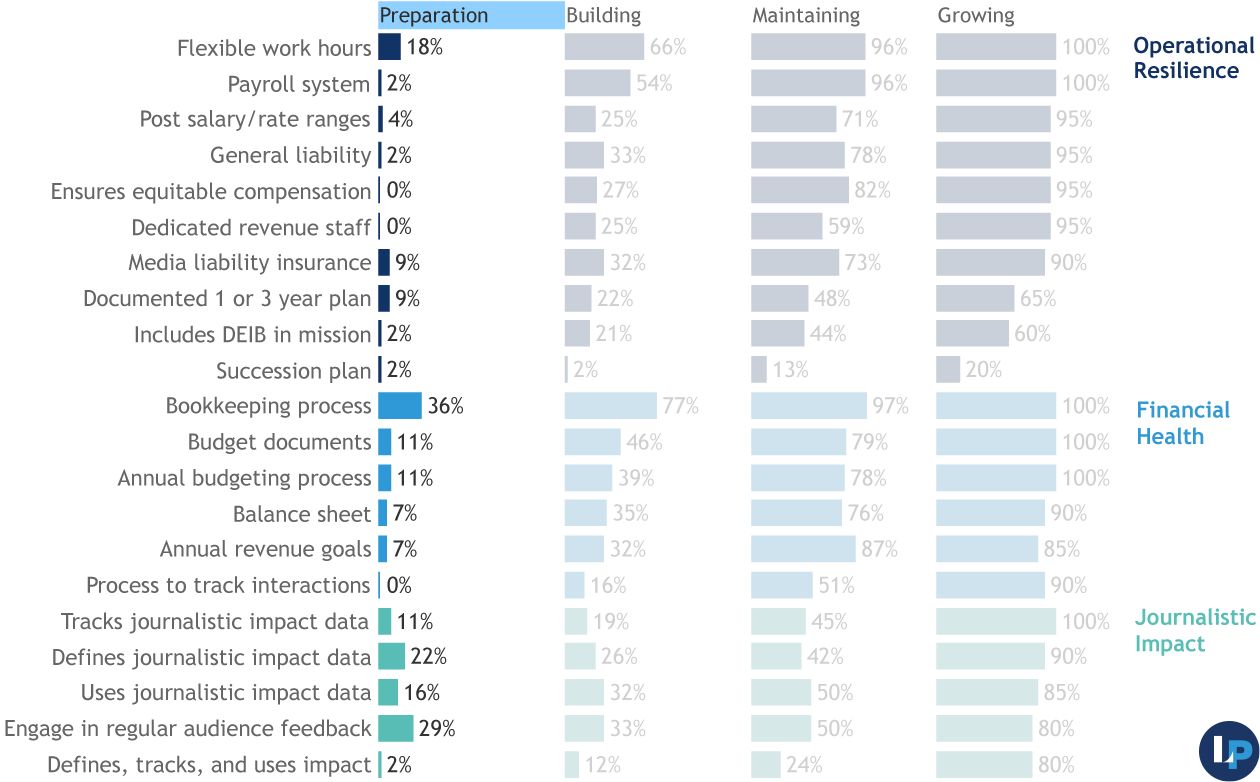
Percent of organizations selecting that they have each key indicator, by stage
Activites by Pillar

Stage:
Preparation

Pillar:
Operational Resilience
Setting Foundations
Small staff sizes tend to be a primary reason Operational Resilience activities are an opportunity in the early stages. Five out of the 10 indicators relate to staff in a way that necessitates having multiple paid contributors. As we saw earlier, the average Preparation organization does not have staff at all. In this way, the Audit works as a roadmap for Preparation organizations, showing what an organization at a more advanced stage looks like.
For example, only 2 percent of Preparation organizations had a payroll system, but the percentage increased dramatically at the next stage (54 percent). The same trends apply to other employment matters, where fewer than one in 10 of Preparation organizations met a given indicator but virtually all of the organizations at the higher stages did.
Adding staff capacity is a major hump for organizations. However, even without staff, Preparation organizations can start planning for the processes and systems to support a future with additional staff. Seventy three percent of participants who entered the program at the Preparation stage had progressed to Building or Maintaining by the time of their follow-up assessment. Organizations in Preparation can identify an appropriate payroll system, determine what equitable compensation looks like, create a policy for work hours, and strategize about what the right role is for the first staff member dedicated to generating revenue.
Most of the key practices prepare organizations without staff to anticipate what systems and practices will be needed when they are ready to hire. It's important to foster awareness of best business practices at the outset.
Preparation organizations, particularly those with 0-1 full time employees, can also build a position of strength by prioritizing practices that do not rely on staff and that correlate with revenue growth: intentional thinking about DEIB policies, having a one- or three-year plan, and having media liability insurance can be accomplished with limited staff capacity. To help make media liability insurance more accessible to early stage organizations, we've secured a discount for LION members.
Median revenue grew by 137% for the 26 organizations that added a documented one- or three-year plan

Stage:
Preparation

Pillar:
Financial Health
Strength in Understanding, Opportunity in Planning
Preparation organizations are in a better position when it comes to implementing key Financial Health practices. This is an important practice for understanding money in, out, and where it has gone.
Almost all of the key Financial Health activities pertain to accounting basics, both having them and using them to gauge the organization's financial health. These activities aren't necessarily meant to earn an organization money, and they might even cost money. But they enable an organization to plan its next phase and pursue it with confidence.
Preparation organizations have a clear opportunity to develop practices that support their planning for the future. Few organizations had forward looking practices in place such as budget documents (11 percent), an annual budgeting process (11 percent), and annual revenue goals (7 percent). It may be challenging to integrate this future-oriented thinking when staff and revenue are small, but getting these practices in place sooner rather than later will provide crucial tools as revenue grows.
There was a significant difference among organizations that implemented forward-looking processes between the Audit and follow up assessment. Four organizations that did not have a budgeting process at the Audit phase but added it by the time they participated in the followup assessment saw their average revenue grow by 84 percent, from $44,433 to $81,565.
Stage:
Preparation

Pillar:
Journalistic Impact
Getting to Know Your Audience and Mission
Journalistic Impact is about mission fulfillment — an organization getting to know its community and intended audience and understanding whether it is providing the value it purports to. Two practices were common at this stage; 29 percent engaged with regular audience feedback and 22 percent had defined journalistic impact. These are building blocks for achieving the related practices needed to fully shape strategy. For instance, while only about one-fifth define journalistic impact for their organization, even fewer tracked it (11 percent) or used it to inform editorial and revenue decisions (16 percent), and only one organization did all three.
Starting with a definition of impact will inform the organization on what to track, and tracking will enable more systematic and intentional use of the data. The tracking portion of these linked practices can be as basic as inputting information into a spreadsheet or word processing document, or as sophisticated as implementing a broad system to track impact.



Contact
If you’re interested in learning more about the data in this report, please email LION’s Director of Data and Evaluation, Chloe Kizer at chloekizer@lionpublishers.com.
If you’re interested in learning how the LION Sustainability Audit can help the news businesses you work with, please reach out to Andrew Rockway at andrewrockway@lionpublishers.com.