
2025 Sustainability Audit Report
A Roadmap for Local News Sustainability


Maintaining Stage
Leaning into What Works
Nearly one third (29 percent) of Audit participants started the program in the Maintaining stage. These organizations had most foundational processes in place. It is the first stage in which some key activities — payroll system, flexible work, bookkeeping processes, and annual revenue goals — were nearly universally implemented. At the same time, seven in 10 organizations had adopted additional significant practices.
Maintaining organizations have foundational elements in place, but there are opportunities for maximizing the potential of processes, as well as ensuring that revenue staff is hired.

Percent of organizations selecting that they have each key indicator, by stage
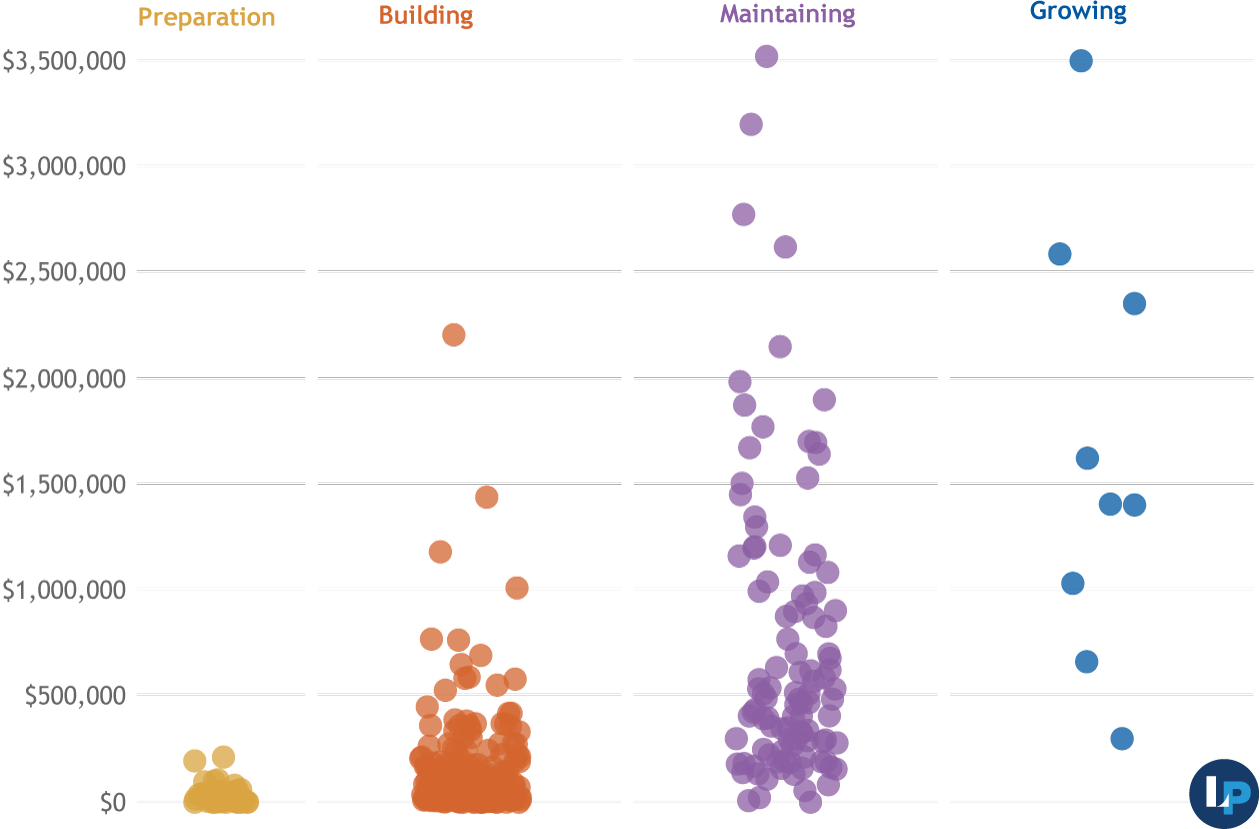
Median revenue was substantially higher than in previous stages, although annual revenues ranged widely, from less than $50,000 to more than $3 million. This suggests that these organizations have the financials and infrastructure in place to generate enough revenue to serve their communities, whether large or small.
Revenue under $1 million likely means the organization is in either Preparation or Building and developing foundational processes. Maintaining and Growing organizations have processes in place and have a wider spread, suggesting that revenue and budget is fine tuned based on scope and addressable market.
There is opportunity for organizations to develop the less frequently adopted practices, primarily systems and strategy, as many organizations didn’t have documented processes for tracking members/subscribers or journalistic impact.
Activites by Pillar

Stage:
Maintaining

Pillar:
Operational Resilience
Protecting Your Business
A key asset of Maintaining organizations is staff: At this stage, organizations had a median of 13 paid contributors, including five full-time employees. Additionally, 82 percent of organizations were taking care to ensure equitable compensation based on roles within teams.
However, only 59 percent of organizations had staff dedicated to generating revenue, which is a hallmark of organizations closest to achieving sustainability. Maintaining organizations that had dedicated revenue staff had nearly twice the median revenue of those that didn’t — $406,000 vs. $800,000.
Building and Maintaining organizations that have dedicated revenue staff have a much higher median revenue than those that do not.

Two other activities were common among Maintaining organizations: Having general liability (78 percent) and media liability (73 percent) insurance. These should likely be universal. Unlike other core activities, carrying insurance does not require staff or a great deal of infrastructure. Instead, they require identifying a broker or policy. This is an area where journalism support organizations can make a significant difference, particularly in an environment where public officials and private citizens might feel emboldened to sue newsrooms. To help address this need, LION Publishers has secured discounted media liability insurance for members. Considering that over 90 percent of organizations in the next stage (Growing), have these activities, they can be taken as a sign of progress toward sustainability.
Case Study

The Kansas City Defender
Kansas City, MO
Year
Audit
Stage
Operational
Resilience
Financial
Health
Journalistic
Impact
2022

Building

Preparation
Building
Building
2023
Building
Building
Building

Maintaining
Founded in 2021, The Kansas City Defender began its Sustainability Audit less than a year into its existence with a clear vision and mission but, as Defender Founder and Executive Editor Ryan Sorrell admits, without the foundations of a sustainable news business.
“The fact is I came into this space with zero knowledge about accounting, financial systems, or nonprofit infrastructure. I'd never even worked in a newsroom and didn't know what a media org chart should look like,’ Sorrell says. “I was an organizer, two years out of college, navigating explosive audience growth and national impact, but with zero knowledge of how to build an organization for the long-term or any type of sustainability. In year one I put 100 percent of my energy into radical community trust, demonstrating the viability of our model, including tremendous time investment into social media engagement, basketball-court takeovers, live music events and more.”
The Audit provided a roadmap for growth: “Once the youth and Black and brown folks across our communities named us their news source,” Sorrell notes, “we back-filled structure: legal counsel, a real payroll, a living employee handbook drafted with our staff, and I began to seek out as much consulting and programs I could to help me build the infrastructure around the vision.”
The Kansas City Defender has since grown from one FTE to four full-time and seven part-time team members, as well as 15 volunteer organizers. Revenue grew from $35,000 in 2022 to $115,000 in 2023, accelerating further in 2024 to $529,000 and with a projected budget of $699,000 in 2025.
Sorrell cites key operational gains:
- Hired a dedicated accountant who cleaned and organized the books dating back to inception.
- Created Defender Handbook guiding internal operations.
- Engaged ongoing pro-bono media legal counsel via Vance Center for International Justice.
- Hired a full-time Director of Revenue & Development in 2025, collaborating with a seasoned Operations & Development Consultant brought on in 2024.
“This program was crucial in providing a roadmap. It broke down sustainability into actionable steps that I could implement right away, or that I could provide any of the consultants I worked with so they could hit the ground running with far less oversight. And frankly, as any under-represented Founder will tell you, we don't just need 'tips and strategies,' we also need resources to implement them. That's another reason I greatly appreciated this as they provided guidance and actual funding to implement the suggestions. This program was as transformative as it was timely.”
Stage:
Maintaining

Pillar:
Financial Health
Ahead of the Curve
Maintaining organizations were generally strong in Financial Health activities, as about three-quarters had all bookkeeping, budget, and revenue processes in place. Many Financial Health activities are cost-effective and sustainable, and they can advance without all of the building blocks of Operational Resilience. So it is common for organizations to be farther along in Financial Health activities than in other areas. Maintaining organizations had a median revenue of $490,000 at outset of the program, almost double the revenue of outlets in the previous stage.
Just over half (51 percent) of these organizations had a process in place for tracking and documenting member/subscriber interactions. This is a Financial Health activity that goes beyond basic accounting practices, and it might be performed by staff dedicated to revenue, audience development, or community engagement.
This activity should lead to greater revenue, as well as stronger relationships with audiences. Organizations that did not have a process for tracking member/subscriber interactions had revenue below the stage's median, while those that did had revenue above it.
It follows that median newsletter subscribers for organizations with a process for tracking members/subscribers are higher as well, about 9,000 compared to 8,000 for those that don’t.
Case Study

The Daily Catch
Red Hook, NY
Year
Audit
Stage
Operational
Resilience
Financial
Health
Journalistic
Impact
2022
Building
Building
Building
Building
2023
Maintaining
Maintaining
Maintaining
Maintaining
The Daily Catch focused on consistent growth across all three pillars of sustainability following their Sustainability Audit in 2022. The organization, which serves communities in the Hudson Valley, had $20,000 in revenue the year before, but they still had sufficient operations, financial planning, and impact activity to qualify as Building. The substantial actions the organization took between the Audit and the follow up a year later included offering medical insurance, creating an employee handbook, developing a one- or three-year plan, purchasing media liability insurance, and - with program funding - defining, tracking, and using impact data The Daily Catch reached the Maintaining stage and its revenue increased by nearly six-fold, to $138,764.
Walter Mullin, publisher of The Daily Catch, attributes their successful growth to consistency and a focused revenue strategy: “We have grown slowly and steadily in every category: fundraising, addition of staff, expansion of coverage areas, and new product offerings. For instance, we effected a merger with a competitor in Rhinebeck to our south, and this allowed us to enhance our fundraising capacity and eliminate duplication between our two news operations.”
Mullin’s advice for other publishers?
“Stay on your skis, don't get ahead of them. We do not want to be bigger for its own sake; we want to be bigger solely to improve our product offering in our predefined market, two towns each of roughly 38 square miles. Most transformative has been our fundraising strategy: identifying key prospects and approaching them with requests for face-to-face meetings accompanied by targeted marketing materials (and Walter's famous cookie goody bags). We have also developed letters we have sent snail-mail, and these break through in ways we could never have anticipated.”
Stage:
Maintaining

Pillar:
Journalistic Impact
Learning Systems
While Maintaining organizations are strong in many areas of Journalistic Impact, they have an opportunity to advance further given their organizational maturity and the systems in place to accomplish complex tasks. Half of Maintaining organizations engaged in regular audience feedback, and half indicated that they used Journalistic Impact data to inform organizational decision making.
As with the other stages, the foundations are set at this stage, as is the ability to implement complex systems. Putting these pieces together to not only gather Journalistic Impact data but to make good use of it, for fundraising as well as for connecting with communities, is a prime opportunity.
Regarding audience, significant numbers of these organizations tracked monthly users to their websites (89 percent) and total audience size (71 percent). But the percentages are smaller when it comes to specifics regarding the audience funnel. Two measures for doing so are tracking returning users and "loyal" users (these were not explicitly defined in the questionnaire). Only half (52 percent) track returning users and even fewer (40 percent) track loyal users. These practices should lead to greater audience insights, product refinements, and editorial strategies that can set the organization up to grow audiences.
Case Study

The New Bedford Light
New Bedford, MA
Year
Audit
Stage
Operational
Resilience
Financial
Health
Journalistic
Impact
2024

Growing
Growing
Maintaining
Maintaining
The New Bedford Light launched in June 2021 with a pro bono editor, publisher, and two freelance reporters. In four years, The Light has expanded to 13 editorial staff members and three business and development staff (a mix of full- and part-time positions). Website visitors average over 200,000 per month in 2025, social reach exceeds 150,000 monthly, and the newsletter has grown to more than 16,000 subscribers. Reader engagement is strong with an average of more than 2 minutes 30 seconds per article. On the fundraising side, The Light has increased revenue every year and raised more than $1.68 million in 2024.
“We have invested in foundational infrastructure pieces that are easy to skip on when being cost conscious, but are critical to success,” says Lean Camara, The Light’s CEO. “This includes a reliable web publishing platform, sufficient editing capacity, content delivered in multiple formats across multiple platforms, community outreach, experienced fundraising staff, and an audience role to measure and expand reach (although it’s only a part-time freelancer role). Our fully-developed, donor centric fundraising approach has provided the resources to support our infrastructure and growth. We invest in our mission and make it a priority to communicate our impact to donors and the communities we serve.”
What advice does Camara have for other LIONs?
“Prioritize what matters most. Our goal isn’t just to grow traffic. It’s to make a difference. Our impact shows up in concrete ways:
- Our coverage has drawn record attendance at school committee meetings.
- When the city council cut funding to the local performing arts center, it was our reporting that alerted the public. The backlash that followed helped restore that funding.
At the core of our success is a clear mission and a team fully aligned with it. Our mission has attracted dedicated, talented staff who carry out the work that leads to our continued success and growth.”



Contact
If you’re interested in learning more about the data in this report, please email LION’s Director of Data and Evaluation, Chloe Kizer at chloekizer@lionpublishers.com.
If you’re interested in learning how the LION Sustainability Audit can help the news businesses you work with, please reach out to Andrew Rockway at andrewrockway@lionpublishers.com.