
Audience analysis, translation, research, and more: How LIONs are using AI
Local news businesses are using AI tools to make their day-to-day work easier and their journalism better.

As independent news entrepreneurs, LION members are constantly innovating, navigating the pressure to find new ways to do more with less. That experimentation can include using artificial intelligence (AI) for both operational and editorial tasks.
The following seven case studies, originally presented at the Media Party NYC workshop “AI in the Newsroom: Practical Workflows for Editors” on May 9, 2026, give insight into how LION members are leveraging AI to strengthen reporting, streamline editorial operations, and expand the capacity of their lean teams — without compromising journalistic integrity. These small- to mid-sized news businesses, from Alaska to New York, are using tools like Claude Code, ChatGPT, NotebookLM, and Google Pinpoint to make their day-to-day work easier and their journalism better.
They’re part of a wave of independent publishers using AI tools to analyze data, generate revenue, support business operations, and more. New LION Sustainability Audit data including questions about AI use shows 89% of 37 news businesses who responded use AI in at least one workflow.
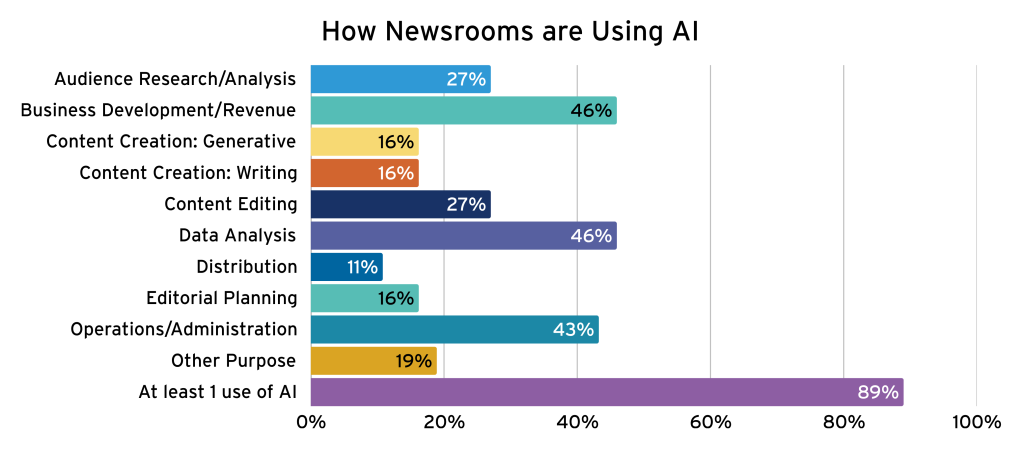
A common theme among the LIONs we interviewed is that they view AI as a tool that saves them time. AI isn’t replacing humans in these newsrooms; it frees them up to offer content and services to their communities that they otherwise couldn’t provide. Many LION members also share a commitment to publishing transparent AI policies and iterating on what they’ve learned. For example, 48% of news businesses that recently completed a Sustainability Audit reported having an AI use policy.
As LION’s community manager, I interviewed the LIONs featured in this article and co-led the live session with Vania André, publisher and editor-in-chief of The Haitian Times, who is also a LION board member. The following excerpts have been edited for length and clarity.
The Haitian Times: Streamlining the editorial process
Location: Brooklyn, New York
Organization Size: 15 full-time employees, with one team member leading the AI strategy and six editors using AI tools regularly
The Haitian Times reports on the Haitian community across borders. Its publisher and editor-in-chief, Vania André, has fully integrated AI into the organization’s editorial workflow – from editing to producing scripts for social media videos.
The heaviest lift is done by ChatGPT, which has been trained on the newsroom’s style and handles about 80% of the editing process.
In addition to editing, the team also uses NotebookLM to support the analysis and research phases of reporting. This tool can help reporters analyze content, such as lengthy studies, by highlighting newsworthy elements. NotebookLM can also extract quotes, characters, and themes. Plus, a tool like Google Pinpoint is helpful for managing large document sets; it can transcribe audio, then highlight strong quotes or areas of note, such as where speakers disagreed with one another.
News in the Grove: Closing the loop with sources and writing basic notices
Location: Forest Grove, Oregon
Organization size: One full-time employee
About 25 miles outside Portland, Oregon, Chas Hundley is the sole operator of News in the Grove, a regional publication, and its sister outlet, The Banks Post. Hundley wanted to proactively send links to his published stories to the people featured in them, but this was time-intensive. So he now uses Claude Code to scan published content for the people and organizations mentioned and automatically send them an email with the published story. Hundley says this follow-up has increased his advertising sales. People who are contacted with the content in which they’re featured then buy advertising.
Hundley also uses Claude Code to write the first draft of basic, single-source notices on fish stocking in lakes around Forest Grove, which is some of the publication’s highest-traffic content. Previously, this content took Hundley 10-15 minutes to write. It now takes him three minutes.
To further audience trust through transparency, Hundley includes an explanation of News in the Grove’s AI use as part of a monthly open house he hosts at his newsroom. Overall, the audience regularly expresses support for his use of AI, and is pleased he’s using it to further his impact as a one-person news business.
AfroLA: Creating visuals (sometimes) and setting boundaries
Location: Los Angeles, California
Organization size: Seven part-time employees, with an additional group of freelancers, contributors, and interns
AfroLA, founded by Dana Amihere, publishes solutions-focused, data-driven, and community-centered journalism for Los Angeles, told through the lens of the Black community.
Keeping L.A.’s most vulnerable groups and communities of color in mind, Amihere explained that transparent disclaimers about what AI is – and isn’t – used for are key. For example, images created with AI are clearly labeled, and AI is only used for image generation in specific cases where privacy protection makes photo use difficult. Supporting Black illustrators is also important for the organization, and human-made illustrations are prioritized whenever possible.
Amihere also said she is aware that AI uses a massive amount of natural resources, and she is still trying to determine the boundaries for when and when not to use it. AfroLA’s ongoing series “Water and Power” investigates the impacts of where and how L.A. gets its water.
“How can we report on that and be a part of the problem?” Amihere said. “Part of our AI use policy is that it’s for ideation, but it’s never our end point. A human touches every piece of content we produce.”
As another example, the AfroLA team uses an AI tool for search engine optimization (SEO). For years, the team has used YESEO, developed by Ryan Restivo. Amihere said it was critical for quickly producing online content during the 2025 L.A. wildfires.
“The draw for me is an AI tool that doesn’t include training models on our content,” Amihere said. “That’s important to me, and addresses one of the sticking points I have with AI usage.”
Enlace Latino NC: Translations and writing code
Location: Raleigh, North Carolina
Organization size: 11 full-time employees, with one team member leading AI use for editorial projects
As a Spanish-language, digital-native media organization, Enlace Latino NC’s main audience is Spanish-speaking Latino and Hispanic communities. However, Nicolás Baintrub, senior reporter and newsletter editor, said the team recognized that some community members prefer or need to consume their news in English. That’s why the team tried a plugin to translate their content from Spanish to English. When the translation quality didn’t meet their standards, the team created a custom GPT. Baintrub designed prompts to support accurate translation, with specifics on things like how to translate direct quotes and use AP style. While this is not an automatic process right now, Baintrub said the team hopes to further develop the workflow and tools.
This process using ChatGPT allows Enlace Latino NC to provide more content in English. For example, the organization increased the frequency of its popular newsletter, “La Tortilla — in English,” from once to twice a month.
Plus, without a programmer on staff, Baintrub uses ChatGPT to write code to provide interactive, “gamified” or quiz-like content for readers on topics such as workers’ rights for H-2A visa holders.
Mat-Su Sentinel: A sounding board
Location: Palmer, Alaska
Organization size: One full-time and one part-time employee who both regularly use AI
This small news business in rural Alaska, Mat-Su Sentinel, has one person, founder Amy Bushatz, handling day-to-day operations and reporting. To get a “second set of eyes” and a sounding board for content such as headlines, she runs her content through ChatGPT. Specifically, she has a two-step editing process with AI, first using the ChatGPT app Copy Edit Pro by Rebecca Nagel.
The GPT edits the content, then produces a bulleted list of corrections for human review.
Bushatz says it knows not to change content within quotes, and she’s trained it on her voice and writing style. After that, she uses the subscription service lex.page to check for readability, passive voice, and AP style.
Bushatz makes sure to review all edits. She said that in an ideal world, she’d like to pair these tools with an additional human editor who isn’t also the writer of the story. In the meantime, she stressed to other one-person reporting teams that don’t use AI for editing support: “You are walking away from the ability to do more with less.”
She also says the ChatGPT editing system doesn’t always work for her. She’ll try having ChatGPT review content; sometimes it aligns with what she’s looking for, and sometimes it doesn’t. When it doesn’t feel right, she doesn’t use it.
Technical.ly: Audience needs analysis and story leads
Location: Philadelphia, Pennsylvania
Organization size: 13 full-time employees, with all staff working on how Technical.ly uses AI
As a national news organization reporting on local innovation economies in the United States, Technical.ly’s Editorial Director Danya Henninger said the organization’s audience is largely technologists, entrepreneurs, policymakers, and people aspiring to those roles. With their most recent annual reader survey, they used AI to analyze their audience across five main geographic focus areas, examining how members of specific demographics within those areas responded to certain questions. Typically, this type of analysis is complex and takes a lot of time and resources; cross-tabs in ChatGPT helped the team break down the responses. The insights gained from this analysis are informing Technical.ly’s business decisions, such as piloting a paid community for members in a certain city.
In the reporting process, automations also help the team in various ways, like with staying on top of workforce reports, which they sometimes use to generate story leads. Technical.ly CEO, co-founder, and publisher Chris Wink built a Claude Code automation that searches weekly for all WARN/layoff notices in states relevant to Technical.ly’s reporting. The automation sorts through information and creates an email with relevant layoffs, then sends it to the right reporters and editors. After just a few weeks of use, data sourced through this process led to a story about potential layoffs in DC from a defense contractor.
They’ve also recently adopted Gemini as the official LLM to use across teams. As a Google Workspace organization, Henninger said Gemini is set up well for the team to directly access this AI within Google Docs, Sheets, and Slides.
Moab Sun News: Replacing a stack of paid software
Location: Moab, Utah
Organization size: One full-time employee who handles AI use, along with a handful of freelance reporters
A daily digital and weekly print publication serving Moab and Grand County in southeastern Utah, the Moab Sun News is run by Maggie McGuire. Working solo, McGuire used Claude Code to write custom “skills” and code that replaced a stack of paid software: the weekly print edition’s ad scheduling (run off an Airtable base), print formatting, social posting, and newsletter prep now run as tools she built, not tasks she repeats.
“There’s a difference between using AI to do a task and using it to build a tool,” she said. “I used it to write software, things that keep working whether or not I’m in the room.”
She frames it as a gap between fields: “Using AI in this way is something people in development and tech are aware of, and people in journalism aren’t,” McGuire said.
McGuire also uses Claude as institutional memory and a way to help the organization continue in an emergency. If something happens to McGuire, she has built out processes in Claude, so her close network will have the instructions and process documentation for tasks such as creating the weekly paper.
Continue the conversation on AI use in local news
Want to take part in conversations about the use of AI in local news? Join LION’s News Entrepreneur Community Slack, which includes an #ai-discussion channel, to learn more about how LION members and other industry colleagues are innovating with AI and other tools to strengthen their news businesses.
Support the 2026 Summit
We're heading to San Diego from September 9–11 for our 2026 Independent News Sustainability Summit. Sponsorship opportunities are now available; check out our deck and connect with us at summit@lionpublishers.com to sign on for next year's conference.
Related Articles
Meet the 17 winners of the 2026 LION Sustainability Awards
We celebrated the 2026 LION Publishers’ Sustainability Awards at the Independent News Sustainability Summit in San Diego.
Sign up to join a LION 2026 peer learning group
Applications will be accepted on a first-come, first-served basis until September 25.
Forget the fads: Why community listening is the future of local news (Q&A with RJI)
From Director of Innovation Kat Duncan: “… what matters is what actually works for the people you’re serving.”