
AI for independent news: 8 questions for AI expert Shira T. Center
‘The smaller the publication, the more opportunity there is for AI to help create value...’

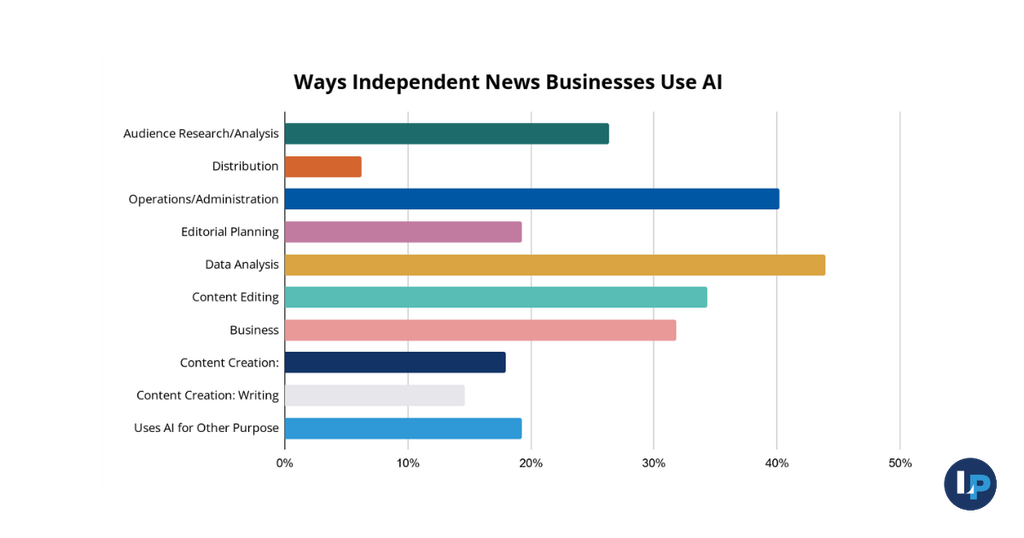
Data from LION Publishers’ Sustainability Audit suggests that the majority (3/4) of independent news businesses that have taken an Audit are using artificial intelligence and related technologies in their day-to-day operations. However, 60% lack a policy governing their use of AI.
Responding to this gap and questions from news businesses, we partnered with Shira T. Center – the vice president for innovation and strategic initiatives at Boston Globe Media Partners, where she leads strategic planning for the company’s key tentpole projects, develops AI initiatives, and creates programs to boost BGMP’s growth and sustainability – to develop an AI Guide for Independent News Businesses. This guide explores the foundational concepts of this emerging technology, helping you decide whether and how your news business might adopt AI and develop guidelines and policies for its use.
To support the launch of this guide, we hosted a Q&A with Shira on the LION News Entrepreneur Community Slack. LIONs submitted their questions, and Shira answered them live. The conversation below has been lightly edited for clarity.
Q: What are some of the more promising ways news businesses are using AI?
Shira: I believe the best use cases are either a) not flashy or b) amplify the business. In other words, they don’t directly touch the reader/audience.
The top use cases I’ve seen include:
- Publishing “help,” such as SEO keywords, headline, and alt-text generation
- Recording and transcribing government meetings for reporting purposes
- Data analysis for business purposes/revenue generation
Q: What are some concerning or improper ways news businesses might use AI? What should I look out for?
Shira: First, it goes without saying (I hope!) that anything generated by AI needs to be double-checked, whether that’s a data result, refined headline, or email to donors. LLMs have improved greatly, but we can’t hold them accountable the way we do with humans.
With that in mind, I’m concerned anytime I see a news organization implement AI as a “replacement” instead of an enhancement. In other words: It shouldn’t write your interview questions, but an LLM could help you research to write better interview questions. It shouldn’t write your headlines, but it can help you write better ones. It shouldn’t do your strategic planning, but it can help you see around blind spots that you wouldn’t have otherwise.
Separately, there’s a lot more risk in using AI for anything that “touches” the reader (think chatbot features, personalization, etc.). By nature, it’s a nondeterministic technology, which means the answer is going to be different each time. This is, in many ways, the opposite of journalism! The publisher has to be OK with taking on some risk and losing control.
Q: Do you have suggestions for if/how to talk to audiences about AI use in newsrooms? What is the right amount of information to give people, and are there any parallels with giving other “behind the curtain” information (e.g., the editorial process, financials, etc.)?
Shira: I do wonder sometimes if having an AI statement on your website is going to look dated in a few years because its use will become so commonplace. Will it be like having a hypothetical disclosure such as “this story used email!” feel in 2026?
That said, there is good research on this! Check out this study from Trusting News.
My two thoughts on this:
- Like the research notes, if you’re using AI for basic newsroom tooling (as opposed to content generation), you’re better off making this a disclosure on your website. This is what many news organizations, including my employer, The Boston Globe, do.
- If you disclose AI use for a specific story, be very clear how you used it; otherwise, you’re leaving this up to the reader’s imagination. I’ll shout out this great disclosure from the Chronicle of Higher Education as an example (included below).
How We Did The Story
The reporter accessed The Chronicle’s internal database of roughly 790,000 university-job listings posted through the company’s career site between 2016 and 2026, and then worked with Claude, an AI assistant, to design and build a filtering script that could identify and extract postings for regional recruiter roles. The reporter reviewed and approved all keyword lists and filtering logic. She had Claude test the script on a smaller, reporter-curated sample of the dataset before handing the full task to Claude Code, a separate command-line tool.
The final dataset, covering a window of May 2022 to July 2026, captured the majority of regional recruiter postings while also being small enough to manually check. The reporter determined whether each posting represented in-state, out-of-state, or combined recruiting activity. The reporter then had Claude scan for trends such as frequency of state mentions and prevalence of in-state versus out-of-state postings. She fact-checked each of those findings.
In-state postings from Texas’ private colleges, which tend to enroll a greater share of nonresidents and fewer total students, were largely absent from the dataset, suggesting they either aren’t investing as aggressively in Texas-based recruitment as their public counterparts, or they didn’t post their jobs through The Chronicle.
Q: My staff use AI to different degrees and for a wide variety of tasks; how should I approach creating policies that work for everyone?
Shira: So here’s the thing about AI: It’s the fastest-moving technology in history. Whatever AI policy you have today may well be outdated in months.
For this reason, I recommend revisiting the policy quarterly so you can keep up with these changes. But I also think it’s good for your staff, so you can keep up with them as they (hopefully) upskill.
Otherwise, in your usage guidelines, I’d focus on what your staff CAN do as opposed to what they can’t. Set the floor, not the ceiling.
Q: How can I know when staff, consultants, contractors, and freelancers are using AI?
Shira: The internet is full of AI “tells,” but the scary truth about this technology is that no one has really developed a foolproof solution to determine whether something was written by an LLM. (Though it may seem obvious in many cases!)
I’d ask yourself when AI use really matters to you and your readers: If a consultant used AI to proofread a memo, do you care about that? How is it different from using a tool such as Grammarly, for example? If a freelancer used AI to fix the lighting in a photograph, does that feel dishonest to you? OK, how is that different from a software program?
These are tough questions. But once you figure out your publication’s “red line,” you should write it into your policies and contracts so everyone is on the same page about when AI use is OK.
Q: What kinds of AI training do you think would be helpful for journalists?
Shira: Without sounding too obvious here, I think the best kind of training for journalists is the kind that they a) finish and b) sticks as a new skill.
When I plan trainings, I want to make sure the users are following along and doing the exercises, not just watching it. That’s a big one! Also, in many cases, less is more: host a prompting “workshop” instead of a general GPT training.
You also want to check in to make sure they’re using what they’ve learned. Sometimes I’ll have a “share what I’ve been doing” session two weeks later, for example.
Q: What do you think a journalism code of ethics for AI could look like?
Shira: I hope it doesn’t change much! I think we’re still accountable for what goes in front of the reader, whether a machine helped with it or not.
That said, I do think it adds to the burden of transparency. We need to be able to tell the reader in clear, plain terms how we got the information and came to the conclusions as a result.
Q: Where do you see the biggest opportunities for AI to help small publishers create entirely new products, services, or revenue streams, rather than simply produce more content with fewer resources?
Shira: The smaller the publication, the more opportunity there is for AI to help create value, in my opinion.
At this point in the technology’s evolution, I’d say the best use cases for small publishers are still on the “business side” – revenue generation/streams. There’s a lot less risk there, and way more upside, potentially.
In second place, I’d say product creation, because that’s become much easier. You don’t need a developer to make an app anymore, for example. However, you still need to design a product that someone wants to use regularly, and that can run sustainably. That’s more difficult than, say, using AI to help create a fundraising plan.
Related Articles
AI for independent news: 8 questions for AI expert Shira T. Center
‘The smaller the publication, the more opportunity there is for AI to help create value…’
LION Publishers has a new strategic plan and mission statement
National nonprofit’s board unanimously approves an ambitious three-year roadmap, guided by clear North Star goal.
100 Australian publishers are getting LION Sustainability Audits
We’re partnering with LINA and adapting our business assessment and related resources to support local, independent news publishers Down Under.