
AI Guide: Addressing Uncertainty and Fostering Experimentation
If you or your team members are skeptical or resistant to AI, they’d be forgiven.
Our work depends on trust and credibility, which leaves little room for error. The industry has also experienced decades of technological disruption, often with painful consequences for jobs, business models, and local communities. It makes sense that many journalists would approach another sweeping technological change with skepticism.
Resistance can take several forms. Before trying to overcome it, ask employees directly what concerns them. Their answers will help you understand their hesitation.
Are there ethical or environmental issues with AI usage that concern them? Fear around economic instability (personal and societal) wrought by this technology? Are they fearful that it will degrade the quality of their work? Or make them less apt at their job (cognitive offloading)?
As a leader, you must acknowledge these, and you also need to understand their “why.” It’s also your job to make sure the most critical voices don’t take over the room.
One way to go about this is to ask them to rate, on a scale of 1-5, their hesitancy or skepticism toward AI. Now at least you know what you’re working with.
Strategies for Understanding and Moving Past Resistance
Empathize. Listen. No, really listen and understand their AI aversion. It may be thoughtful, or it may be visceral. The goal here is not to prove them wrong but to fully see where they are.
Educate. People fear what they don’t know. If your team is relying on headlines and hearsay to understand AI, then they are not seeing the benefits. While it’s rarely a good idea to mandate AI use, you can ask that people learn about this new technology. AI will have a material impact on how they do their jobs in the coming years, whether they are journalists or salespeople, and whether they’re using it personally.
Empower. Give people the tools they need, and the guidance and governance so they can proceed with confidence. Let them be their own drivers. Be supportive at first even if the idea isn’t remarkable. They can build and iterate quickly.
Experiment. By framing AI usage as an experiment or pilot, you can take the pressure off of adoption or any long-term behavioral change.
Fostering a Culture of Experimentation
The traditional news cycle doesn't leave a lot of room to try new things. But pilots, testing, and experimentation have never been more important. The key is to not treat it as a one-off, but rather as a structured process. Make it more of a science than an art.
In the practice of innovation, one of the most common ways to do this is through “stages” and “gates.” In short, “stages” are the phases of conceptualizing and proving a new idea or initiative, and “gates” are the hurdles that a product must pass before going on to the next stage. Robert Cooper originated this framework for corporations in the 1980s, and here’s a version that’s been adopted for smaller-scale experiments in news organizations:

(Image created by ChatGPT: Author is responsible for text and adaptation from Cooper’s framework)
The above can be applied to any new process or product launch, so what does AI have to do with it? It can speed this process up so it takes a fraction of the time. You can brainstorm, build, and test more quickly than just a couple years ago. Some examples:
- Use AI as a brainstorming partner and for basic research, even to help define your business case
- Use AI to tell you how to build a solution and create the minimum viable product
- Some large media companies employ “synthetic research” – creating research subjects through AI that match their desired population or personas – and get their feedback
- Collect and analyze user feedback
The above might seem like a lot of work, but the application of rigor, structure, and data results should go a long way to making your case to hesitant colleagues. Just be sure not to make the process so cumbersome that your team avoids experimentation altogether.
Especially with hesitant teammates, one useful framework might be to distinguish between indoor and outdoor experiments:
- Indoor experiments are trials that never touch the reader, such as A/B tests or operational workflows.
- Outdoor experiments get results in the wild, such as when you test content with a pop-up newsletter or trial a new advertisement type for a sponsor.
Indoor experiments can be lower stakes. In fact, the lower the risk, the easier it will be for hesitant employees to begin.
The Importance of Building the Landmark Use Case
If this seems like a lot, consider that you’re not just building a specific tool for a task or workflow. You’re laying the foundation for an AI-enabled organization and a more efficient, capable, and future-proof organization.
Once you have that landmark use case, you need to make sure people know about its success and, ideally, have them start using it as well. It just takes one big use case to spark inspiration and adoption.
Five More Ways to Build a More Experimental Culture
For larger teams with goals of AI adoption, you may want to consider a more formal effort to foster an experimental culture in your news organization.
- Let peers lead each other with “learning sessions” to show how they are using AI.
- Have a “hack day” or “idea pitch” to give teams an opportunity to share their experiments or solutions. You can have different winner categories (“most promising idea,” “best for business,” or “employee choice”)
- “Jam sessions” over lunch that are inherently informal, in which peers can get together (virtually or in real life) and chat through their AI workflows.
- Be the change by showing your team how you’re using AI in your daily work.
- Celebrate (and normalize) failures: not every solution, small or big, will work. Some companies even have “wakes” for ideas that didn’t make it.
Showing Results (ROI)
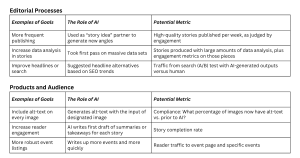
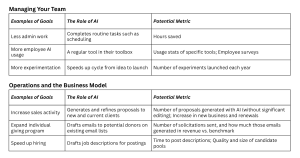
At this point, you’ve made an investment in how to use AI at your organization – whether that’s time, financial, or other resources. You’ll want to show the results of this work or at least track whether it’s been successful. It’s not an easy investment to measure, so start first with what you’re trying to achieve across the four impact areas.
Final Tips and Takeaways
Give your team sanctioned tools with guidelines. If you give your team vetted tools and guardrails on what is acceptable use, they’re going to be able to proceed with confidence.
Stress the benefits, not the features. AI can do so many things, it's overwhelming. Stress the immediate benefits (you’ll get hours in your day back!), as opposed to the functions (“It can write emails for you!”).
Lean into data, not vibes. Take notes on the impact of AI tools, either yours or those created by your peers. Consider metrics such as hours saved, new prospects found, or investigations reported.
Frame AI as a force multiplier. Say it over and over again if you must: we want AI to empower you to focus on the work that makes human reporting so valuable and will allow you to pursue those things. AI is not a replacement for you or your value.
Be honest about AI’s shortcomings. It’s an imperfect technology. Be clear about what AI is good for and what it isn’t. Be able to explain why it’s probabilistic and non-deterministic and what risks come with that.
Reinforce Accountability and Transparency. Both you and your readers should know if AI was used in a material way for a result. AI is the technology – humans remain responsible.
Additional Reading and Resources
Generative AI was used to refine the writing and check content on this page. All content was created, reviewed, and verified by a human, who takes full responsibility for its accuracy.