
Trove of LION Audit data reveals what a ‘Sustaining’ news business looks like in 2026
More than 400 news businesses later, we’ve adjusted our maturity model to better reflect resiliency in the sector.

It’s been a year since LION Publishers launched the on-demand version of the Sustainability Audit, available to all LION members at any time. Since then, 440 news businesses have completed the Audit a total of 480 times, a few dozen more than we did in the previous three years combined. This means that since 2022, we’ve conducted more than 900 Audits for nearly 600 news businesses.
We’ve learned a lot over the last five years. The Audit has become our main vehicle for measuring the overall health of independent news businesses using our Sustainability Pillars and maturity model, and increasingly, others are using it to do the same. And in our latest round of Audit data analysis, the first time we’ve had data from over 400 newsrooms in the same year, we came to an exciting conclusion: We know what real progress toward sustainability looks like for news businesses.
Introducing: The Sustaining stage
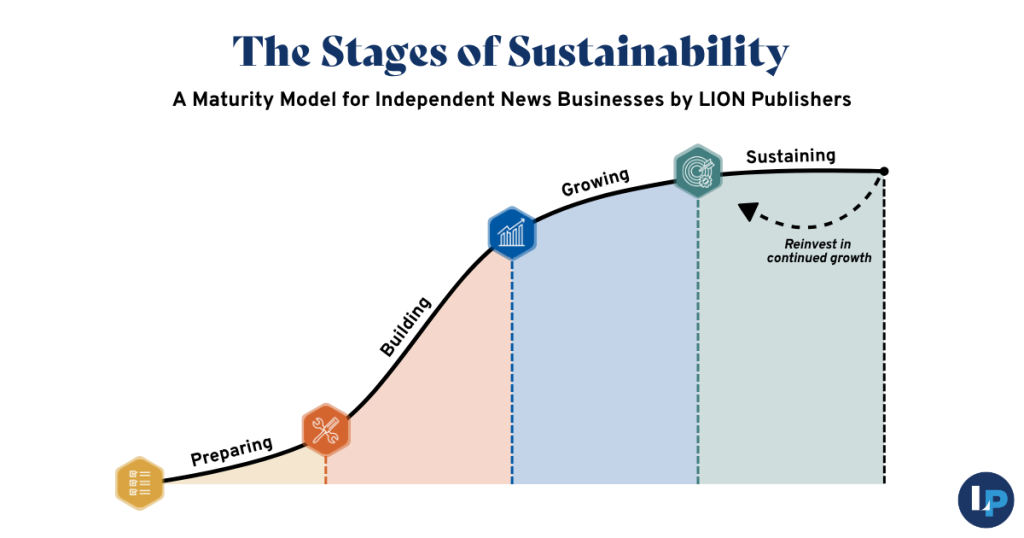
Sustaining news businesses have built foundational and mission-critical operational and financial infrastructure. They have reached a level of viability across the three pillars of sustainability and are often working to scale or establish clear succession plans.
Sustaining is characterized by a newsroom’s ability to:
- Capitalize on growth opportunities, whether that’s through new products or new markets
- Maintain operations during a leadership transition
- Weather a challenge within two pillars simultaneously
- Be flexible and informed enough to move with the tide, shifting product and audience strategies to stay relevant in a rapidly changing regulatory, cultural, and technological environment
The Audit is a point-in-time assessment. That’s why we’ve named the stage “Sustaining” instead of “Sustainable.” We see the relationship between the Growing and Sustaining stages as cyclical, with many organizations that have reached Sustaining shifting into periods of Growing as they expand or reimagine their business.
We don’t claim to be prophetic. However, after reviewing four years of data, we’re confident in our ability to assess whether an organization, at a given moment, has strong enough operational infrastructure and business performance to indicate resilience. The reality of business ownership is that factors beyond anyone’s control will impact operations. What news business leaders can control is increasing their resilience to whatever may come next. The Audit is designed to measure this type of resilience, and a handful of the organizations we’ve measured over the past year have achieved the newly defined Sustaining stage.
At the moment, 11 Audited organizations (of the 440 total from ’25-’26) sit within the Sustaining stage, and we’re looking forward to sharing more about their successes later this fall.

How we got here
We overhauled our stage assignment methodology.
The Audit identifies the strengths and needs of independent newsrooms and surfaces challenges and opportunities common across the ecosystem. A major strength of the tool is that it doesn’t just measure business outcomes – revenue, audience size, etc. – but also digs into the why and how through questions about processes and planning.
The Audit and maturity model were designed to work together to present snapshots of organizations’ journey as businesses. And this large new batch of data helped refine our thinking and set updated benchmarks for quantitative business health metrics. Our previous model accurately captured the volume of practices and processes, but undervalued business health metrics. For example, total staff doesn’t tell the whole story. We’ve added a staff-to-revenue ratio to assess how well an organization can support existing levels of contributors.
To address this, we reworked our methodology to reflect established news business development pathways, guided by expert recommendations and Audit data. We:
- Mapped each Audit question to a single sustainability stage,
- Set new scores for responses based on importance, and
- Scored quantitative data, like audience size and revenue, more highly
As a result, for a business to reach the Growing stage, they’d need to have a critical mass of indicators from the Preparing, Building, and Growing stages AND quantitative metrics in line with their Growing-stage peers.
These changes led to a significant shift in overall stage assignments when we applied our updated methodology to previous Audit results.

We feel these changes better capture the position of more Audit takers, acknowledging that there’s room for development in both critical process infrastructure and in total revenue, staffing, and audience figures.
The domino effect: We’ve updated the rest of our maturity model in response.
We’ve updated our other three sustainability stages to better reflect the position of the newsrooms within each stage, absorbing the Maintaining stage (which previously sat between the Building and Growing stages), bumping the Growing stage into the third position, and adding the Sustaining stage that captures the highest performers.
This update in the stages doesn’t mean that news organizations are moving backward if they go down a stage in an updated Audit. Instead, they now have even better data that can help busy publishers identify where an investment of time, resources, and energy could have the most significant impact on their business, and their bottom line, so they can make data-informed decisions about what to do next.
What’s next
Beyond the big changes above, as news leaders retake the Audit, they’ll notice a few additional changes:
- Benchmarks in the report have been updated to reflect 2025 data. They are still presented by overall stage, but we plan to make that logic more complex to show Audit takers data that reflects a subset of organizations more similar to themselves in revenue, geographic scope, and audience size.
- Staffing-related recommendations show up less frequently for solopreneurs. We heard that it was frustrating to be presented with recommendations on managing a team when that feels far off, and adjusted the underlying logic in response.
- AI utilization and process questions have been added to better capture how news businesses are using and managing the associated risks of this technology.
- More robust validation of staffing and revenue data to ensure that aggregated figures match the itemized data provided across revenue streams and business-segment staffing. We recognize that we ask for a lot of information, and now the survey will let you know if anything looks off before submission.
We have a backlog of feature improvements and analyses that we can’t wait to share with you. Be on the lookout next week for an update that will offer you a closer look at Audit data, and we plan to provide Audit updates on a regular basis.
Throughout the summer, we’ll also continue to update our Audit report recommendations to reflect current best practices and information, including producing new resources (like a how-to guide for using AI in smaller newsrooms). As always, if you have questions or thoughts about the Audit, reach out to Andrew Rockway anytime at andrewrockway@lionpublishers.com.
Deepest thanks to all 440 news businesses who took an Audit and the partners who have helped us reach such a wide swath of the field so quickly. We couldn’t do this work without you.
LION members can take an Audit anytime through the member portal. For independent publishers who took an Audit between ’22-’24 and are not an active member, you can reach out to membership@lionpublishers.com to discuss renewing your membership.
Related Articles
100 Australian publishers are getting LION Sustainability Audits
We’re partnering with LINA and adapting our business assessment and related resources to support local, independent news publishers Down Under.
Why LION is getting out of the big-conference business (for now)
An FAQ of sorts about how we’re setting our sights on different ways to convene in 2027
LION now accepting applications from for-profit news businesses for free HR and financial consulting
Open to newsrooms, solopreneurs, and creators, get a customized, cost-effective plan to run your business more efficiently.