
AI Guide: Foundational Concepts
Areas of Impact: A Framework for AI in Journalism
The number of available AI tools, the variety of potential use cases, and the pace of AI development can seem unwieldy — like you don’t know where to begin exploring the topic, let alone consider the wide-ranging impacts on the news publishing and information ecosystem. Let's start by categorizing how AI will impact news businesses.
Editorial processes
The myriad of ways that AI can be used to change the news gathering and reporting processes– like sifting through documents for investigations or “listening” to and transcribing or summarizing hours-long school board meetings.
News products
This includes changes to how people consume news and information, such as personalizing the news experience, converting content into multiple formats, and other ways to engage an audience.
Managing people
AI can be a force multiplier, but only if it is adopted thoughtfully and responsibly. Standards, expectations, and clear policies are critical for preparing staff and contractors for this major technology shift.
Operations and the business model
This includes the many behind-the-scenes operational use cases for AI, plus the overall business impact as user behavior changes, competitors adapt (or don’t), and broader economic shifts affect news consumption and production.
Some of these areas will be more relevant to you than others, depending on your journalism and business models. But every publication will have to grapple with AI’s effect on each area to some degree, if they aren’t already.
Understanding Artificial Intelligence
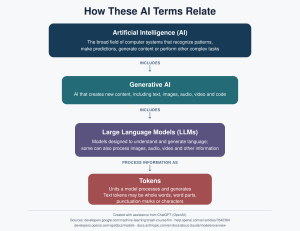
There are many kinds of “Artificial Intelligence.” Think of Artificial Intelligence, or AI, as an umbrella term for computer systems that perform tasks typically associated with human intelligence, such as recognizing patterns, making predictions, understanding language, and generating content.
When people talk about AI today, they are often referring to Generative AI, which creates new content based on patterns learned during training. That content can include text, images, audio, video, code, or other material.
It’s helpful to think of Generative AI as part “sponge” and part “prediction machine.” The “sponge” is what it’s absorbed (learned) from vast amounts of information. Depending on the model, that information may include public internet content, books, images, code, and, yes, news. That information “sponge” then processes (squeezes) that information and puts it into patterns that it can recognize. Generative AI then uses those patterns to predict an answer (an output). This is why the answers often sound right, even when they aren’t.
- The units an LLM processes and generates are called tokens. In text, a token might be a whole word, part of a word, punctuation, or a single character. Tokens are also used to represent other forms of information in some image and audio systems.
- A model is a system that’s been trained and refined on a large corpus of data and learns statistical patterns. These are used by applications, such as Claude or ChatGPT.
- A Large Language Model (LLM) is trained to process and generate language, but newer models can also do images, audio, or video. ChatGPT, for example, uses other models to produce different formats.
- Multimodal Models can process and deliver outputs across formats (or modes), such as audio, images, or video. That said, the lines here are increasingly blurry: Most LLMs can offer outputs in any format.
How AI Works
AI models need to be trained, and given the large amount of data and information that this requires, this is not as simple a process. Training is what computer scientists do to help the model “learn” and recognize patterns. Because AI turns words into numbers, which are put into predictions, they can be adjusted or “weighted” to produce more accurate or relevant outputs.
Another key term is “inference,” a best guess based on new inputs. In AI, those inputs are the data and training, and an inference is the logical conclusion. It’s what powers the output.
A prompt is what you put into the AI. These can be simple (“proof this email”) or they can be complex and prescriptive (“proof this email for an audience of donors who know little about the news business”). Generally, the more specific the prompt, the better the result is going to be. Think of it as a set of instructions that you give the machine.
Outside of their training, AI has a limit to what it can remember and apply to a set of outputs. This is what’s known as a “context window.” You can increase a context window, but there’s a downside — both in speed (it has to scroll through a longer working memory before replying) and cost.
Retrieval-Augmented Generation, or a “RAG,” improves Large Language Model responses by adding another layer of data or context. For example: A publisher could connect an AI search tool to its archive. When a reporter asks what the city council previously said about a development project, the system retrieves relevant articles and supplies them to the model before it answers. RAGs also greatly reduce hallucinations (see below), because the machine is relying on data sets more specific to your task.
Non-Deterministic outputs are what make AI different from so many other technological processes. If you plug two numbers into two cells on a spreadsheet, and then add them together in a third cell, you will always get the same answer. These are deterministic results, because when the ingredients are the same, the outputs will be the same. By contrast, AI produces non-deterministic results because they can be different every time — even if you’ve given it the same input or prompt. This is because the outputs are probabilistic.
A hallucination refers to an incorrect, ungrounded, or otherwise false output. Given AI outputs are generated by probabilities, some might say that every output is a hallucination. But colloquially, this usually refers to incorrect outputs.
It’s part of the reason why, when people talk about the infrastructure around AI, they often also mention the importance of a “Human-in-the-loop” (or HITL). The high-level concept is that some processes that rely on accuracy (such as journalism) need to have a human who can greenlight or adjust outputs. However, in practice, this can mean a lot of different things: Does the human fully edit the output, or give a high-level judgment on it? The practical application can vary widely by organization.
A “loop” also describes the multi-step cycle through which the model thinks, generates an output, takes in feedback, and adjusts. Sometimes it’s a human that provides the feedback, and other times an AI agent can be instructed to manage this process on its own. (You may have heard of the “AI Doom Loop,” in which you give feedback to the LLM, and the results progressively get worse instead of improving.)
Lastly, there’s Agentic AI — a term that is often thrown around to describe a myriad of use cases but actually means something quite specific. It’s a type of AI (like Generative AI) that can work autonomously to act on a human’s behalf and make decisions. Because agents can take actions — not merely suggest them — they need clear limits, permissions, checkpoints, and human review. An error in a draft is one thing; an agent publishing, emailing, or modifying records based on that error is another.
What AI Does, and Doesn't, Do Well
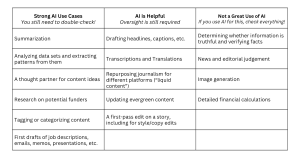
Just like any tool or technology, AI can’t do everything. There are some tasks and skills that are just not a good fit for AI. In journalism, especially, AI will never replace human editorial judgment, empathy, connection, or verification.
It’s helpful to consider where AI is really good and where it still needs a lot of human review:
Additional Reading and Resources
- Google’s comprehensive Machine Learning glossary
- Intro to AI: A Beginner’s Guide to Artificial Intelligence from MIT Technology Review (Email Newsletter)
- Introduction to AI for Journalists by Google News Initiative
- Online News Association’s AI in Journalism Initiative
Generative AI was used to refine the writing and check content on this page. All content was created, reviewed, and verified by a human, who takes full responsibility for its accuracy.